I’ve seen many friends work through this, and I’ve been there myself. Several years ago, I was a children’s book editor in NYC. I was living the English major dream! And it was amazing, in so many ways. I got to work on fun projects, like the relaunch of Nancy Drew and The Hardy Boys for modern kids; attend events like Madeleine L’Engle’s 80th birthday party; and, probably the most fulfilling part of all, help new writers find broad audiences and become famous among ten year olds, their parents, and teachers. I was making an impact!
So, you might be wondering, what exactly was the problem here?
I don’t think career change always needs to be about a problem — although there was the pay, which was pretty meager then for college graduates going into children’s editorial and, I suspect, still relatively small. My then-new husband and I wanted to do grown-up things like own a home and have a dog, both crazy expensive in NYC. However, my job was so fulfilling that I would have gotten by continuing to volunteer at dog shelters and continuing to pile into an apartment the size of one of those tiny IKEA room models. But what really inspired me to start thinking seriously about change was some exposure I was getting to dot com life. I sniffed an opportunity I was missing.
At nights and on weekends, I was starting to dabble in digital content, writing for mostly food + restaurant websites that were cropping up left and right (dot com boom). It was FUN! I was writing about stuff I loved (food writing, mainly), and I was connecting with our audience (customers) super fast. And, added bonus: the money felt like a fortune. I started to wonder: Is there something I could do professionally in digital (which is SUPER broad, but that’s how I was thinking) that could be just as, if not more, fulfilling, and provide me with the paycheck to own more than 450 sq. ft., and maybe a patch of grass?
The answer is, yes! Fast forward a year, and I was in digital product management.
Easy? Nope. Also, it’s not always this fast. I know a lot of people who have changed careers, and it’s taken them longer. Everyone’s circumstances are different. But if you’re thinking about a change, here’s what I did that has also worked for a bunch of “transitioners” I’ve come to know:
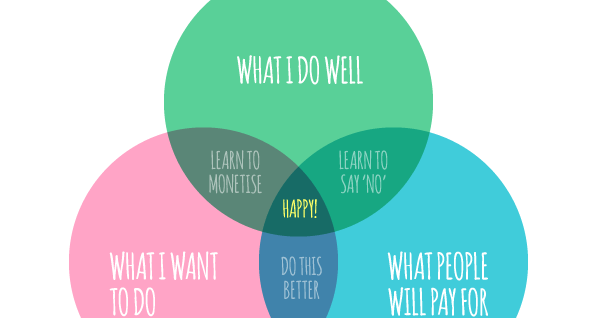
1) Think about what you do well, what you want to do, and what is attractive to employers or in the market. Don’t think in terms of job descriptions, think in terms of skills and qualities. Kind of like what you see in this Venn diagram, which I credit to this post about the intersection of entrepreneurship and meaning (if you don’t want to be an entrepreneur, don’t worry — still relevant!):
Just by going through this exercise, you’ll become 100x more aware of where you want to be, directionally. It’s unlikely, though, that you’ll be left with a handy set of job title keywords to plug in. That’s why you need to…
2) Talk with a TON of people. Get set for a lot of coffee dates. My sister-in-law was telling me the other day that to pivot in her career, she had about 87 coffees. 87! This might seem high to you, but it might actually be low depending on how far you are from knowing where you want to go with your career. These conversations are not about open jobs. They’re conversations to learn more about people who are in areas you think could be a good fit for you based on how you filled in your Venn. It’s to find people you identify with, who are in roles you think could be super satisfying. (A nice side benefit is that one of these coffees will likely lead to your next job.)
3) In between coffee dates, do some job searches by plugging in some of the specific skills and strengths you’ve decided, in step 1, are what you want to cultivate AND what are valuable in the market. For me, these were initially terms like: Writer. Editor. Content. Communications. Children’s content. Food writing. Manage freelancers. Think of lots of different ways to say the same thing, and play around in your fave search engine. By doing this, I started to find job listings, and triangulate on job titles that could be a good fit. When these searches would lead me to interviews, I’d try to find out more about other things I valued, like having an impact in some way, or working with really smart and motivated people who like learning.
5) Repeat steps 3 and 4 until you find a job listing that says “I’m yours!”
One thing I did that catalyzed this process was move to a whole new place. If you have a yearning for something different, something “more” — but you’re in a pretty comfortable job + career — you may find it difficult to pursue a change. If you know in your “heart of hearts” that you want a change, you might need a jump start. This step isn’t for everyone; it’s highly dependent on your circumstances.
As for me, I didn’t go right into product management. My stepping stone was content management. After thinking through my strengths and what I had that was valuable to others, and having lots of coffees, I plugged in some terms like “editor” and “kids” and found a listing: Content Producer. My future manager was looking for someone with experience in children’s content, but didn’t feel a need to hire someone with a ton of digital experience. We got along well in the interview, and he offered me a job. There, I was exposed to product management and, a few more coffees later, realized that that’s where I really belonged, given what was in the middle of my Venn. And by the end of the year, that’s where I was.
I’m continuously inspired by stories of career change, and excited to talk to and help people who are in the midst of plotting one. If you’ve read this post, you probably are too. Comment or chime in with questions or comments or, if you want to chat direct, reach out!

By Jen Handler, Lean & Agile Product Management expert
Originally published at https://www.linkedin.com on February 20, 2017.
 Epic Outcomes | Coaching & Consulting
Leave a comment